

University Retirement Communities (URCs) represent one of the fastest-growing senior living models, being driven by a boomer demographic 73 million strong, controlling 70% of the nation’s wealth and representing the most highly educated retirement demographic in history. Communities associated with Stanford, Duke, Notre Dame, Penn State and Cornell are just a few of the nearly 90 URCs that can be found on the website UniversityRetirementCommunities.com.
Many URCs exceed industry benchmarks for pre-sale and post-occupancy lease-up, followed by years’ long wait lists. With more than 10,000 boomers turning 75 each day for the next decade, the current number of URCs may represent a fraction of potential growth among more than 2,600 four-year universities and colleges nationwide. In total, boomers represent a large and economically powerful demographic that does not see themselves as “old,” while seeking active, intellectually stimulating and intergenerational retirement environments. A university connection offers precisely that, presenting senior living providers a unique and generational strategic opportunity.
But as attractive as the URC model is, it is also one of the most complex to execute. There may be no more perfect of an example of an “Odd Couple” than large, bureaucratic academic institutions focused on 20-year-olds and senior living providers with a focus on individuals a half century older or more. For both parties, success depends on a careful blend of vision, planning and partnership to maximize success on what can be a 50- to 100-year commitment. Based on lessons learned from both the most successful and troubled URCs, here are five imperatives for any senior living owner, developer or operator to consider:
1. Have the Patience of Job
“University time” is a fact of life requiring accommodation. The phrase, “Let’s meet again next semester,” (i.e., in six months or longer) can represent standard operating procedure for in-progress projects, which in turn may be included in long-term campus plans requiring board of visitor or state-level approval for any change. Yes, the payoff can be large — a community that can access the university brand and millions of dollars of resources and remain the #1 choice in the market for decades. But if you are a senior living provider in need of a quick ROI or unwilling to tolerate life in the university slow lane, this model may not work for you.
2. Conduct an Initial “Go/No-Go” Review
Conversely, not every university or college offers a good URC opportunity. Before jumping in, an initial review is essential to determine a viable campus-connected community.
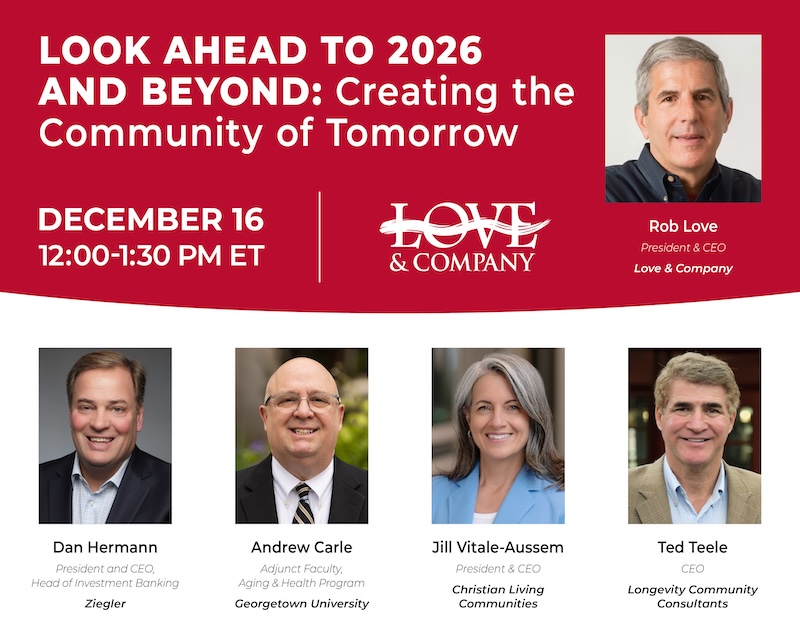
Create the Community of Tomorrow
With 2026 opening unprecedented opportunities for nonprofit growth, now is the time to rethink what the community of the future must be. In our December 16, 2025 webinar, Love & Company President & CEO Rob Love, and a panel of senior living thought leaders discussed how organizations can grow strategically to meet the expectations of tomorrow’s prospects.
Externally, complete an assessment of traditional senior living feasibility factors, and also those specific to URCs:
- Is there a location of sufficient size and proximity to the campus, and one cognizant of needed boundaries between residents and students? Many of the nation’s largest and oldest universities have no proximate location.
- Does the market offer sufficient labor supply? Many college towns include higher income demographics limiting availability of hourly staff, though with access to high quality, low cost (even free) student labor.
- What is the extent of potential regional or national interest, including alums? URCs commonly receive interest from residents willing to relocate from 100 to more than 1,000 miles away.
- Given an expanded service area, are existing or proposed URC competitors within a one- to two-hour drive? A larger, better school?
Assessing internal academic strengths and weaknesses is equally important. Large, well-ranked Division I universities with a strong alumni base, lifelong learning program, high-level athletic and visual and performing arts, relevant curricula and attractive, accessible facilities and grounds are more likely to succeed. By contrast, small liberal arts colleges in rural areas may struggle to support such a venture, or even to survive. Through research and consulting to numerous URCs, I’ve developed a 21-point rubric to rank academic host opportunity in four categories:
- “Very Attractive” (17-21 points)
- “Attractive” (12-16 points)
- “Potentially Attractive” (6-11 points)
- “Unattractive” (5 points or fewer)
Each of the first three categories offers opportunities across a range of additionally required information. Those scoring 5 points or fewer are unlikely to offer either a viable, let alone long-term opportunity for both senior living providers and academic institutions.
3. Offer What Retirees Are Looking For—Not What You Want to Provide
To thrive, a URC must deliver what residents with an interest in the model seek. As just one example, multiple surveys have found approximately 90% of retirees expressing URC interest desire a full continuum of services (IL, AL/MC, SNF), nearly double the interest in any other feature. Yes, higher level services can be hard to staff and economically deliver, but this desire makes sense when you consider that one third to more than three quarters of URC residents can be university alumni or retired faculty or staff. Residents loyal to the host university or college a half century or more are not planning to leave, nor should the community or academic host risk the marketing, philanthropic and reputational damage resulting from requiring them to do so.
4. Don’t Dabble. Be “Best in Class”
The URC sector remains new and evolving. Up to 80% of current communities maintain only informal and varying degrees of connection with an academic institution. But the remaining 20% (and most successful) have taken the model to the next level, representing the highest level of operational, financial and cultural integration with an academic host. This model in turn has focused on five criteria established in 2006 that define not a URC, but a higher level ”University Based Retirement Community (UBRC)”, including:
- Close proximity to the host academic institution: Typically, one mile or less to ensure easy access to both the community and campus environment for residents, students, faculty and staff.
- A full continuum of IL, AL,MCand skilled nursing services, allowing residents, spouses or partners to remain in the community as service and care level needs increase.
- Formalized programming between the community and the academic institution, defining resident-related benefits and access, and structuring of internship and related learning opportunities for students.
- A formal business relationship between the community and the academic institution, such as a land lease, licensing agreement, contract medical or related services or other business connection(s)establishinga mutual interest in the long-term success of the community.
- A resident population that includes at least a 10% mix of academic institution alumni, retired faculty or staff, establishing the university culture as a component of community life.
Launched in 2023, the first program recognizing Certified UBRCs, based on the 5-criteria model, is bringing needed structure to the sector, while providing a road map for “Best in Class” success.
5. Invest in a “Dean of Residents”
Every successful URC requires a dedicated professional who bridges the gap between residents, students and the university. Whether funded by the senior living provider, the university or as a shared expense, a “Dean of Residents” or similar ensures that programming and benefits are maximized and remain strong over time. Without such a role, connections can be lost, and the partnership risks becoming transactional rather than transformational.
Conclusion
URCs represent a powerful response to the desires of boomers and the evolving role of senior living and academic institutions. But success is not automatic, requiring careful planning, strategic fit, a proven model and dedicated leadership. By following these imperatives, both senior living providers and academic institutions can create communities that enrich lives and stand the test of time.
Andrew Carle is a 30+ year senior living executive and lead instructor for the graduate curricula in Senior Living Administration at Georgetown University. In 2006, he created a five-criteria model defining a “University Based Retirement Community (UBRC)” and has published, presented and consulted on URCs nationwide. He currently serves as founder of UniversityRetirementCommunities.com, offering the first directory, information resource and certification program for this rapidly growing sector.