

“Is moving independent living occupancy from 93% to 97% actually worth it?”
On paper the answer should be straightforward. Fewer vacancies mean greater revenue.
Yet surprisingly few organizations pursue those last few percentage points of occupancy, especially when they’re hitting their budget goal. Based on my experience visiting communities over the years, assuming you can’t close those last few percentage points of occupancy can be an extremely expensive assumption, because full occupancy is so often within reach.
What do I mean by an expensive assumption?
Life Plan Communities that don’t ask the right questions often overlook a very reasonable opportunity to add millions of dollars in unrealized seed capital for growth or self-investment.
The Math We Rarely Finish
Missed the Webinar?
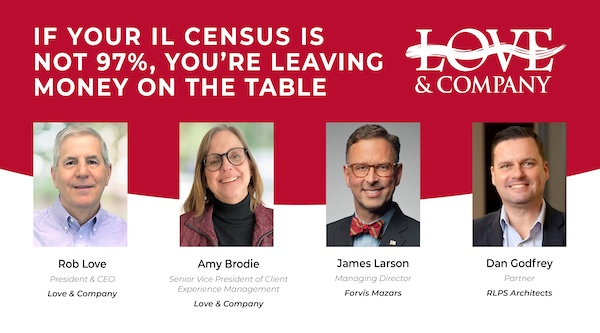
Maximizing independent living occupancy from 93% to 97% can unlock millions in additional revenue and capital for growth, yet many Life Plan Communities overlook this opportunity. Love & Company President & CEO Rob Love, and a panel of senior living thought leaders explored how to evaluate, invest in, and strategically pursue full occupancy to drive long term financial impact.
Let’s start with a calculation every CFO knows. I’ll use a monthly service fee of a hard-to-sell apartment in my region to illustrate the magnitude of the opportunity we’re talking about. (Use the calculator I’ll share later to apply this example to your own situation.)
If I have a moderate-sized community of about 250 residences, and if I’m meeting budget at 93% instead of stretching for 97%, that means there are 10 currently empty residences that we should be trying to fill. (I’m using 97% because it accounts for the ongoing gaps between re-occupancies.)
Each of these vacancies represents an average of about $4,000 of unrealized revenue per month , or $48,000 per year , plus an average entrance fee of about $250,000.
At first glance those dollar amounts do not feel transformational. But filling all 10 of those otherwise vacant residences adds $480,000 in annual revenue.
Over a typical 8-year lifespan of someone in independent living, that becomes about $3,800,000 in annual monthly fee revenue . Add in the entrance fees of about $2,500,000, and those 10 residences just generated about $6.3 million for the community.
This isn’t just revenue. It’s internally generated growth capital. So, investing in filling those next 10 vacancies is not just about bolstering or protecting the operating budget. It’s about stewardship of your mission for the next 20 to 30 years.
What does this mean for you? With this kind of organizational upside, we believe every Life Plan Community leadership team should ask themselves:
- What would it take for us to reach functionally full capacity (97%)?
- Would the investment and effort be worth it?
The Real Threefold Question
With today’s strong market of age- and income-qualified prospects, unless you have fundamentally obsolete product issues, we believe 97% is an achievable and sustainable goal.
Most CFOs don’t need another occupancy initiative for selling a few more residences today. They need a way to pressure-test assumptions and ideas that will sell those remaining residences both now and again each time they turn over in the years ahead.
So the real question is: Is the investment in money, time and organizational focus worth it for your community?
You can only answer this question by exploring the three key aspects that determine whether the “juice” of increased revenue is worth the “squeeze” of incremental move-ins.
- What level of upfront expense will bring this inventory up to market expectations so you can determine what each move-in will really net the community—after the capital and operating expenses needed to get it sold?
- Is the annual incremental accumulation of new entrance fees and monthly revenue a viable, valuable growth strategy?
- If some inventory is potentially already obsolete today, what does that mean for 2030 and 2040?
How much revenue is tied up in your vacancies?
Use our calculator to estimate the revenue and growth capital your community may be missing from open residences.
Assess Yourself for Growth & Sustainability
Based on our experience helping development teams and operators prepare unit mix and product decisions that meet the needs of today’s and tomorrow’s prospects, there are three ways to think about achieving a sustained 97% occupancy.
- You refine and augment your sales and marketing program to enable you to target and convert the specific prospects needed to sell your remaining inventory.
- You improve the desirability of your hardest-to-sell inventory through renovation and staging strategies.
- You eliminate the hardest-to-sell residences, which are typically the smallest ones, through combinations.
Love & Company is experienced at assessing the marketing and product issues that might be holding you back from achieving functionally full census. Today, the demand for senior living is growing significantly faster than the supply, and growth opportunities abound for not-for-profit senior living. And often the easiest, most constructive way to strengthen your financial standing and prepare for growth is to maximize occupancy at your current community.
We know the questions to ask and would be happy to explore a growth and sustainability discussion with you. Our conversation will help your leadership team consider whether functionally full capacity is a viable option. In the meantime, use this calculation tool to take a high-level look at the magnitude of accumulated revenue and entrance fees you may be leaving on the table.
Please contact Wayne Langley at wlangley@loveandcompany.com to schedule a conversation.