

Have you ever felt “stuck” as a marketing leader? You have a strong product and solid demand … and yet some of your best apartments still aren’t selling the way they should?
My community, Providence Point, is beautiful. We have a strong reputation and an incredible product. In fact, we are arguably one of the best Life Plan Communities in the region. And yet we had 10 brand-new “Franklin Court” apartments sitting unsold on top of heavy attrition. We dipped below 90% occupancy and were stuck there despite everyone trying harder. I could find no logical reason why. Something wasn’t working and it didn’t make sense.
I was forced to stop asking “what new campaign idea should I run?” and start asking, “what am I missing?”
At the same time, my leadership started leaning into that question, too. My CEO encouraged me to be open to getting an outside perspective.
Embracing Support (Even When It’s Uncomfortable)
I’ll be vulnerable and admit I felt some personal tension. As a marketing leader, being asked if you want to bring in a consultant can feel like a threat. But I chose to see it as my CEO intended it, as support—support with urgency. There was pressure to act quickly, so I embraced the idea and looked for a 360-degree review of everything that goes into our sales and marketing effectiveness.
We commissioned an assessment from Love & Company in October, with the goal of getting results in December. My experience and intuition also told me we shouldn’t wait to take action. So, I asked my assessment partner to start working with my team right away. Our sales advisor, Joan Kelly-Kincade, immediately came on site, observing the team, experiencing the culture and seeing how things worked in real time.
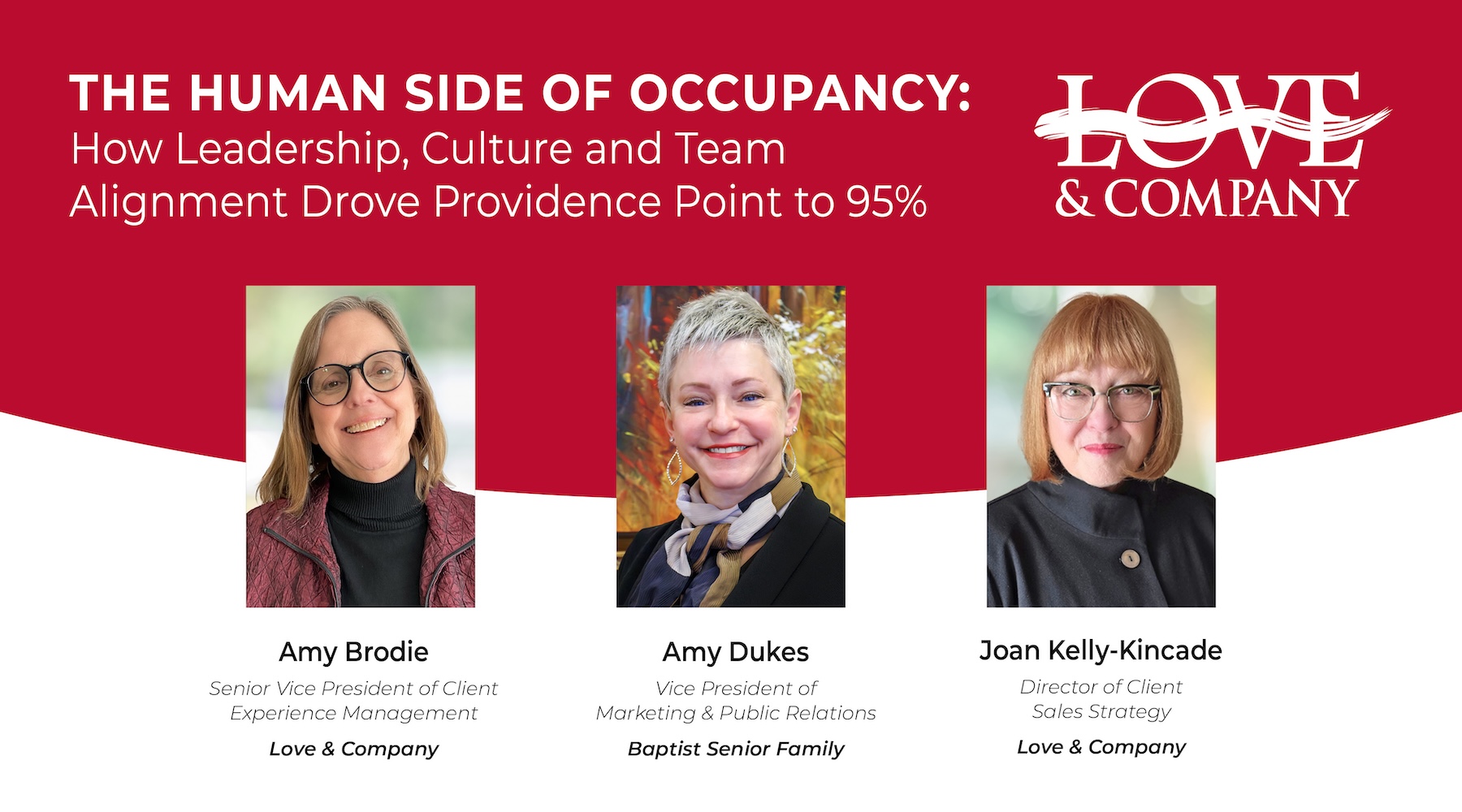
The Human Side of Occupancy: How Leadership, Culture and Team Alignment Drove Providence Point to 95%
This panel-style webinar allowed Amy Dukes, the VP of Marketing & Public Relations at Baptist Senior Family (Providence Point) and her main support from Love & Company, to share the specific decisions and changes they made and the lessons other marketing leaders can apply to strengthen alignment, performance and the resident experience.
The Data That Changed Our Perspective
The fresh eyes approach was invaluable. When I saw how our inquiry rate compared to senior living benchmarks, I knew our number of qualified leads wasn’t the issue. We had already spent the marketing money to acquire the right number of leads. The assessment’s time study shined a glaring spotlight on the core issue, i.e., which tasks my sales counselors were doing and—critically—how long they spent doing them!
My counselors were incredibly dedicated—but they were doing everything. I mean everything. They were managing the entire move-in process themselves, handling details that could have been supported by others. So even though they were busy all day, very little of that time was spent in the selling zone. The assessment showed us that this is where our disconnect was centered.
Getting Counselors Back in the Selling Zone
It wasn’t a staffing numbers issue—it was a structure issue. Once I saw that, the path forward became clear, we didn’t need another sales counselor (my CEO was thrilled to learn this); we needed stronger support roles in the office and team discipline to allow each person to own their role so the sales counselors could actually spend time building relationships and nurturing leads.
Another consequence of the roles confusion was that follow-up was inconsistent. Because of benchmark data, we knew we had the leads we needed, but we learned that we needed quicker and more personalized follow-up. And we were right! Once we helped the counselors to stay focused in the selling zone by trusting the support systems around them, we started to see real change in the sales results.
We certainly had other factors that helped our big turnaround, but the most interesting and most impactful other factor had little to do with sales and marketing tactics. The factor we needed to address required an understanding of human nature, in terms of how the attitude our staff and residents had developed about the apartments that weren’t selling.
Perception vs. Reality: The Coffee Shop Solution
Another big insight that came out of this assessment was that our staff felt the new apartments were too far away from our amenities. For the longest time, they felt convinced that the new apartments couldn’t sell because they were just too distant. This feeling was shared by our current residents, which led to lukewarm word-of-mouth activity surrounding these new apartments (and these residents are normally quite active at referring their friends).
But I counted steps; the new apartments are no farther away, and in some cases they are closer than the familiar apartments. It was pure perception by people (staff included) who weren’t used to traveling those hallways. The apartments “felt” like somewhere else. What could we do?
During the assessment, we noticed an under-utilized beauty salon close to the new apartments and asked ourselves: What if we made this a community destination — a coffee shop? We pulled out all the stops and gave our residents and staff a great reason to travel into less traveled part of campus.
All of a sudden, staff and residents were getting their caffeine fix in the new shop. All of a sudden, the new apartments didn’t feel far away. All of a sudden, the new apartments started to sell!
The Results: From Stuck to Unstuck
As I write this, our occupancy has already surpassed my CEO’s original goal. We welcomed in some fresh eyes when we were in the mid-80’s in census, and we’ve just reached 96% months ahead of schedule!
It all started when we embraced a 360-degree assessment. The data showed us what was happening, and having a trusted partner on site helped us to understand why.
It wasn’t a marketing issue—it was about people and process: counselors were overextended and under focused on selling; time in the selling zone was limited; and sales was happening in isolation.
So we rebalanced roles, created time to sell, improved follow-up and rebuilt trust amongst the team.
And that’s what changed the experience for our leads—and drove the results. That’s what got me unstuck!
I hope my experience can help others be open to a fresh view of your challenges. Sometimes the answer isn’t a new campaign or more leads—it’s looking at what you already have through new eyes and asking the harder question: What are we missing?