

I was thrilled as our team reached our 141st presale and secured financing for what I’m told is the second largest expansion in the country.
But that milestone was far from certain. Just 12 months earlier, reaching that goal—let alone within that time frame—looked completely out of reach. Even three months earlier, we thought we’d need a miracle.
But we made that miracle happen, and I learned four game-changing lessons through the adventure.
We underestimated what the project required
Horizon House is a 65-year-old tower-based Life Plan Community located in downtown Seattle, with a remarkable and unique culture, and the great reputation to match. When this 198-apartment expansion project began, we had 371 independent living residences and 91 assisted living and memory care residences, and a very healthy Future Resident List.
The year prior to recruiting me in 2023, the board made the bold decision to expand as a way to better serve our mission. In hindsight, we approached the expansion as though the hard part was deciding to build. We should have been simultaneously building the sales and marketing infrastructure. Instead, we treated those as separate steps, when they needed to happen concurrently.
The warning signs showed up during 10% conversions
Initially, things seemed fine. Reservation deposits quickly grew, as did the first few months of 10% conversions. But after the first wave of reservations, momentum stalled and I had a growing sense that something fundamental was missing. We worked harder, but I started suspecting we had skipped a step somewhere.
My instincts were telling me something was wrong
This was my first expansion experience, as I was relatively new to the Life Plan Community sector. My instincts were telling me something was wrong, but I didn’t have decades of senior living experience behind me. Still, I knew the results didn’t make sense.
So, I started talking with many wonderful leaders throughout senior living and the validation was immediate. People confirmed what I was already feeling and that gave me the confidence to push for change.
The diagnostic approach changed everything
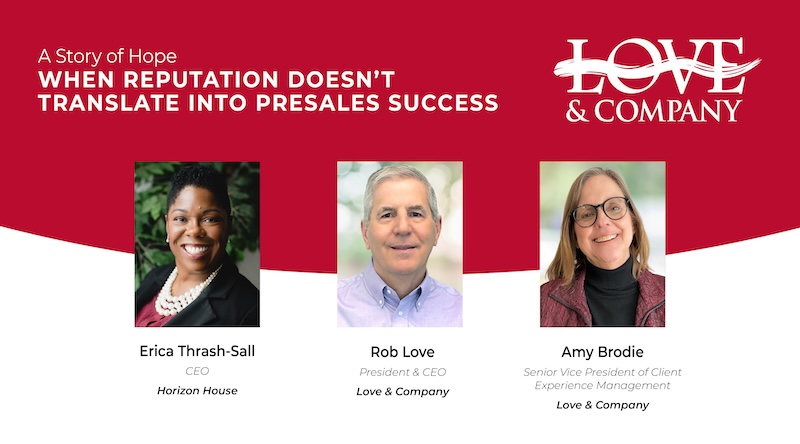
A Story of Hope When Reputation Doesn’t Translate Into Presales Success
This panel-style webinar allowed Erica Thrash-Sall, the CEO of Horizon House and her main support from Love & Company, to share the remarkable story of overcoming stalled sales to achieve financing success—and the lessons every Life Plan Community leader can apply to their own expansion journey.
I wasn’t looking for someone to simply execute tactics better. I needed someone who has been through expansions many times, in many situations to help us understand what was actually happening. So with our desired financing target about one year away, we called Love & Company. I made it clear we had already tried working harder; I wanted them to diagnose what had gone wrong, so we could work smarter.
It made for a very busy December, but they came onsite, got to know us and really surprised me with what they saw.
The answer was both simple and uncomfortable. We had plenty of qualified people entering the funnel and touring. Plenty of prospects were engaging. They simply weren’t converting.
Once we saw the data, it became impossible to blame the market, the economy or Seattle. It became clear, the issue was us. Specifically, it was the experience we were creating.
Game-changer #1: Realizing we weren’t rolling out the red carpet
One of the diagnostic observations that changed everything came during a campus tour.
The Love & Company team pointed out that we were essentially bringing prospects through the back of the house, as if a restaurant was leading guests through the kitchen before showing them the dining room.
Once it was said, it became so obvious to me. We’re a downtown, urban community, and having guests come to our main entrance involved real logistical problems that led us to make marketing guests come through the back entrance, walking down stairs and through uninspiring spaces. When you’re full and have no trouble refilling vacancies, this can go unnoticed.
But this approach was not creating the kind of experience that matched the significance of the decision we were asking people to make for this upscale expansion.
So we started changing things. Not huge things, but practical things that focused on hospitality and a prospect-centered approach to tours, and to every interaction. The impact was remarkable.
Game-changer #2: The entire organization got involved
One of the biggest shifts happened when we stopped treating sales as the responsibility of the sales team. Like many organizations, we had people who assumed occupancy was someone else’s job, and that changed when we saw Love & Company’s feedback.
We created visibility around our goals by sharing data and starting regular marketing-focused huddles among the operations team.
Most importantly, once we helped staff understand how their role affected the prospective resident experience, the transformation was incredible. Our valet team, our front desk and our managers all became invested. These teams started asking questions about outcomes. They wanted to know whether specific prospects deposited and asked for direct feedback on whether and how their efforts were making an impact.
The question I hear most often now is, “How can we help?” That question changed our culture.
Game-changer #3: Focus on the right leads, not just more leads
Something that really jumped out to Love & Company was how far below goal our referral leads were. We didn’t have nearly enough community outreach, or encouraging or activity from the friends of residents. When we saw how that affected our budget and our conversion rates, it made us realize we couldn’t (and shouldn’t) just throw money at getting more leads—we needed referral leads, specifically, because those convert much higher and at a much faster rate. From that point on, my board, my staff and I really focused on getting out into the community and making sure Horizon House and the West Tower were top of mind for all our key affinity groups.
Game-changer #4: Data created clarity
Perhaps the biggest difference-maker was the data. Prior to Love & Company joining us, we were operating largely on assumptions. Now, I see exactly where people enter the process and where they drop out.
The data gave our team confidence and focus. It helped us prioritize and, most importantly, it helped us understand that success was still possible. It gave us hope that we could hit our financing goal on schedule. And when we entered the summer of 2025 still feeling like we needed a miracle to meet a fall financing, data lay at the heart of the crucial 100-day push that made the fall miracle become reality. I used data to help each department understand how they could impact our sales and marketing process, and we achieved something I’m told is unheard of. We generated 30 presales in two and half months—a year and a half into presales—to achieve our finance target!
The story isn’t over
People sometimes talk about our turnaround as though it’s finished. It’s not. Financing was just a milestone, not the finish line. Today we’re focused on keeping all those future households engaged through a long journey toward move-in. That work matters just as much as earning the deposit in the first place.
I’m proud to share this presale turnaround story now, to give hope to any colleagues considering growth. Still, I encourage anyone starting an expansion: Don’t wait until you’re behind to invest in sales and marketing. Those investments aren’t supporting the project. In many ways, they are the project.
If you’d like to learn more about the Horizon House story and its lessons for all Life Plan Communities, planning an expansion or fine-tuning a occupancy on existing residences, watch Erica’s webinar here, and contact Wayne Langley at wlangley@loveandcompany.com or 301-663-1239.